
2027 Ground Transportation Tech Stack: 8 Priorities for High-Volume Operators
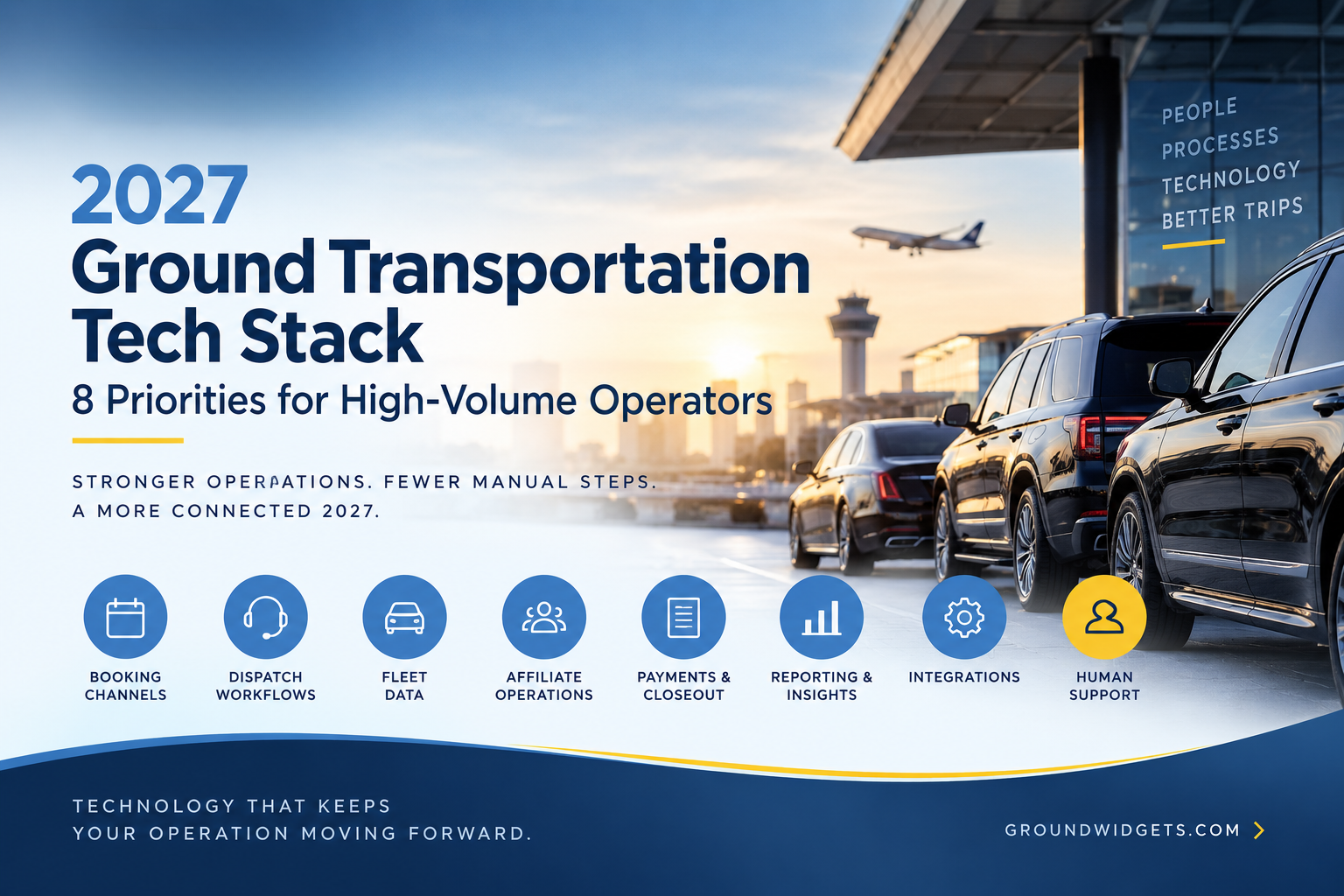
Your next technology investment should solve a specific operating problem—not add another application. Use these eight priorities to choose where to improve workflows for 2027.
Choose where to startTest the Handoffs—not Just the Features
Illustrative scenarioAn affiliate-served corporate trip changes after the chauffeur has been assigned. Where is the new pickup time recorded? How does the affiliate acknowledge it? How does dispatch know the chauffeur has the latest instructions—and who follows up when an acknowledgement does not arrive?
Use this scenario to evaluate the complete workflow, including exceptions. The GroundWidgets ecosystem spans the review areas below; prioritize the handoffs your operation needs to improve.
Connect Your Booking Channels
Map your booking channels and note where staff re-enter details. Pay particular attention to changes and cancellations that arrive separately from the original reservation.
SantaCruz supports reservation channels including web, mobile, digital telephony, corporate booking tools, and agency channels. GroundSpan focuses on connecting agency and corporate travel reservations with ground transportation workflows.
For each connection, identify which details arrive automatically and which require staff validation.
Automate Routine Dispatch Work
Separate repeatable assignments and status updates from decisions that require client knowledge or operational judgment.
SantaCruz gives dispatch teams configurable views, filtering tools, automation rules, and automatic-dispatching capabilities. GroundPad connects chauffeurs with reservation details, dispatch messages, acknowledgements, and trip-status reporting.
Define which actions the system should handle, what needs approval, and who responds when an expected update is missing.
Turn Fleet Data Into Action
Choose the fleet information your team needs, the action it should prompt, and who is responsible for following up.
GroundTrack provides vehicle-location information, historical route review, geofencing, alerts, and monitoring of activity such as speed, idling, harsh braking, and rapid acceleration.
Use a location event to prompt a trip review, an idling pattern to start a coaching conversation, or route history to investigate a service question. When location data supports a billing review, check it against the agreed rates, service terms, and trip details.
Keep Affiliate Handoffs Connected
Follow a farmed-out trip from the initial offer to final charges. Where do acknowledgements, changes, and status updates enter the process?
GroundXchange supports the exchange of reservation information, dispatch statuses, changes, and ride-closeout data between participating operators through integrated back-office systems.
With your most-used partners, verify the exchanged information, change acknowledgements, and closeout details. Agree on a fallback when an expected update is missing.
Simplify Trip Closeout and Payments
Follow a completed ride through expense review, final charges, payment activity, and reconciliation. Note where information has to be entered again.
SantaCruz supports billing, invoicing, payment, and closeout workflows. GroundPay connects payment activity with the back office, including authorizations, transaction review, refunds, voids, reconciliation, and reporting within supported processing environments.
Test both a straightforward ride and one with a changed fare, missing expense information, or a refund request. Keep the checks and approvals needed for accurate closeout.
Build Reporting Around Decisions
Choose the management decision before requesting a report. Which trips remain unclosed? Where are final charges missing? Which service exceptions need attention?
SantaCruz includes reporting tools and customizable dashboards to support operational review.
Start with a small set of measures relevant to your operation, then identify the fields and reporting setup needed to track them.
Test What Your Integrations Exchange
Evaluate the information exchanged by each connection—not just whether a product appears on an integration list.
Does the connection transfer a reservation only, or also changes and cancellations? Does it carry final charges? Who needs to activate it?
GroundSpan supports agency and corporate booking connectivity and integration with back-office systems.
Put Human Support Where It Matters
Identify the work that still requires a person: interpreting requests, resolving exceptions, coordinating changes, or communicating with customers.
GroundOps provides trained operational support for functions including reservations, dispatch and trip monitoring, after-hours coverage, billing, affiliate coordination, and back-office work. Its service model is aligned to agreed workflows, responsibilities, and coverage requirements.
Define support responsibilities, escalation authority, and the handoffs between the support team and your internal staff.
Where Should Your Operation Start?
Address service-critical gaps first. Then prioritize recurring work by its frequency, staff time, business impact, and the effort required to improve it. Use the guide below to choose a starting point and establish a baseline.
| When the recurring problem is… | Start by reviewing… | Establish a baseline using… |
|---|---|---|
| Employees re-enter reservations or changes | Reservation intake and booking connections | Share of bookings requiring re-entry; handling time |
| Dispatch repeatedly calls for routine updates | Chauffeur communication and status workflows | Status-check calls or messages per 100 trips |
| Affiliate trips need repeated follow-up | Partner data exchanges and handoff procedures | Trips missing an agreed update or final-charge detail |
| Completed rides remain unfinished in the back office | Trip closeout, billing, and payment workflows | Time from ride completion to financial closeout |
| Managers routinely cover operational gaps | After-hours coverage and escalation responsibilities | Manager interventions by shift or coverage period |
Use these as suggested internal measures—not industry benchmarks. Confirm how your team will collect each measure; some may require configuration, exports, or a manual baseline.
One problem. One owner. One measured improvement.
Assign an owner, record the current workload, and test the revised process before expanding it. Include the approvals that must remain under human review and a fallback for exceptions.
Measure whether manual work decreases without increasing missed updates, unresolved exceptions, or service problems. Use those results to decide whether to expand, adjust, or pause the change.
Build a More Connected Operation
Your next improvement may be a configuration change, an integration, a different workflow, or additional operational support—not a complete system replacement. Start with a service-critical gap or a well-defined source of avoidable work, and measure the result.
What Should Your Operation Improve First?
Tell GroundWidgets where reservations, dispatch, affiliate handoffs, or billing still require manual work. Discuss the options that fit your systems, service requirements, and 2027 priorities.
Discuss Your 2027 PrioritiesConfirm specific features, integrations, configuration requirements, and service scope with GroundWidgets when evaluating a solution for your business.